Will the New York Bottle Bill change?
As alterations to the Bottle Bill depend on New York State passing changes, the answer is maybe. This is politics after all! But, the main issues being deliberated include:
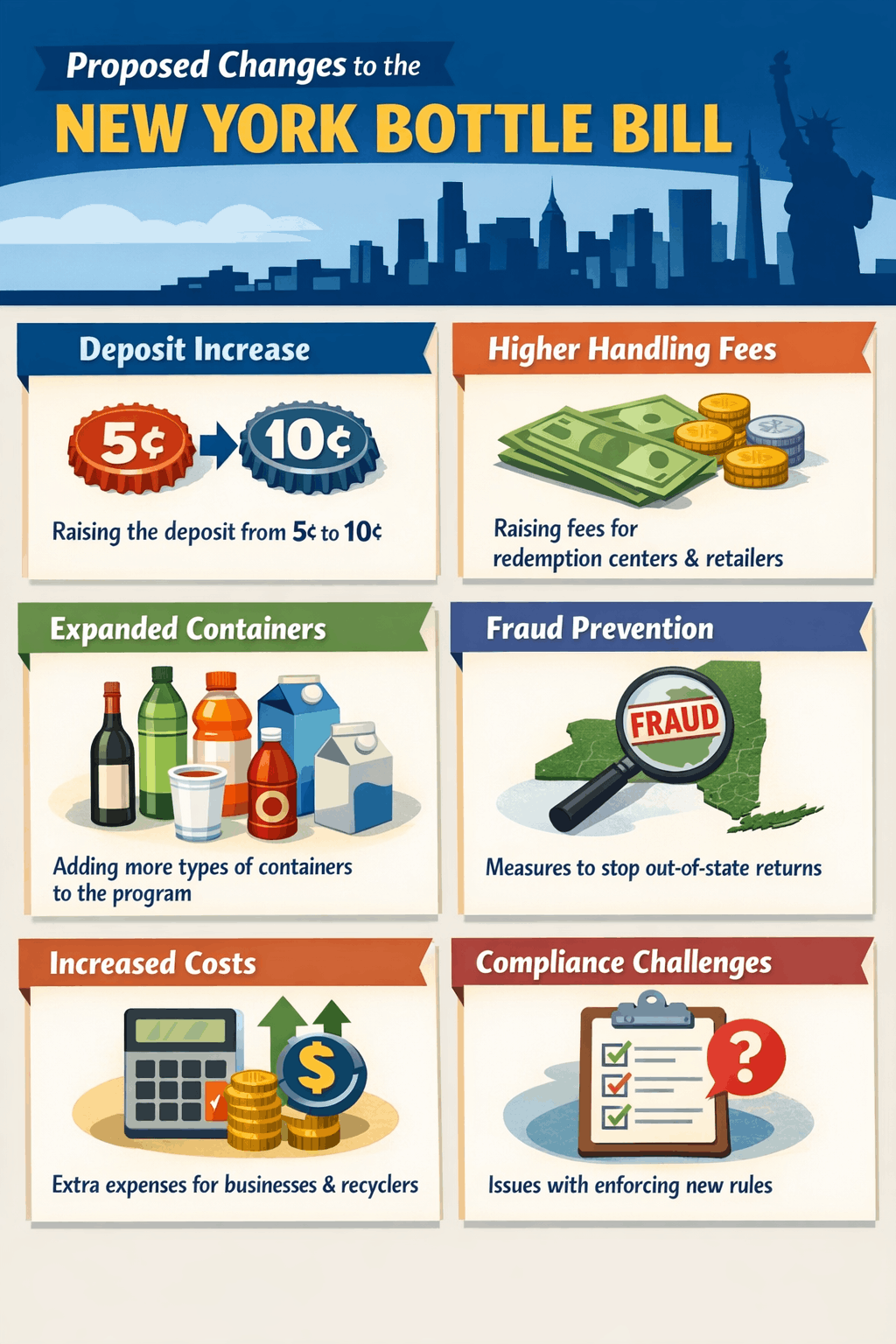
- Raising the deposit from 5 cents to 10 cents,
- Raising the handling fee for redemption centers and retailers,
- Expanding what kinds of containers will qualify for a deposit,
- Fraud prevention,
- Extra costs of doing business,
- And, compliance issues.
There’s a lot going on in Albany that’s catching my attention when it comes to updating the Returnable Container Act – aka, the “Bottle Bill”. The thing is, even though the law is still working, the world around it has changed a lot since the last big update back in 2009. The beverage market has evolved, operating costs have gone up, and the risks of fraud have increased. All these changes are putting pressure on the system, making it clear that it’s time for a refresh.
The scope of the system is actually quite large. According to DEC, back in 2022, a staggering nine billion deposit containers were sold, and about 6.4 billion of them were redeemed. That’s a redemption rate of ~70%. What’s more, DEC claims that the Bottle Bill has been really effective in reducing litter from beverage containers by a whopping ~70%. There are several bill proposals being considered right now that could make some big updates. If you are interested in diving into them yourself, all of the new bill proposals in the state Senate are linked in the citations at the bottom of this page.
Ongoing Debates About Proposed Changes to the Bottle Bill
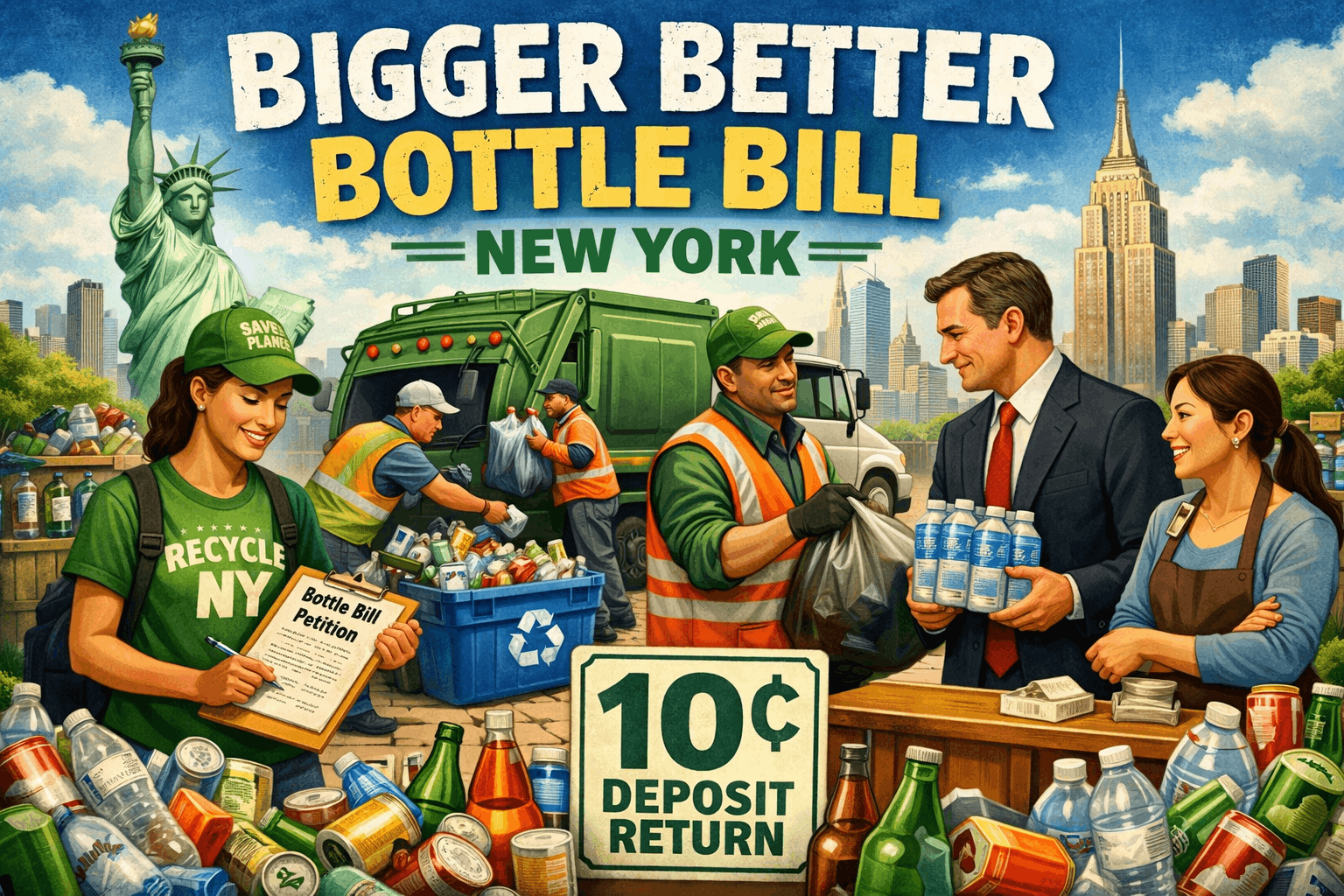
The debate is not “change or no change.” It’s which type of change, how fast, and who bears the cost. The main idea being discussed is the “Bigger Better Bottle Bill”, which is also known as S5684, introduced by Senator Rachel May, and A6543, introduced by Assembly Member Deborah Glick.
This proposal has a few key goals:
- It wants to increase the deposit refund value to 10 cents, but this won’t happen until April 1, 2027.
- Additionally, it plans to raise the handling fee, but this will be done in stages – it will start at 5 cents right away, then go up to 6 cents in 2027, and finally reach 6.5 cents in 2032.
- Another important part of this proposal is that it will expand what types of drinks are included in the program, which is often referred to as a “covered beverage”.
That “what counts as a beverage” piece is where the bill becomes a true overhaul. The Assembly memo explains a phased approach:
- it first adds popular non-carbonated categories (like noncarbonated soft drinks, less-than-100% juice drinks, coffee/tea beverages, carbonated fruit beverages, and cider).
- Then, starting April 1, 2030, moves toward treating “any drinkable liquid intended for human oral consumption” as a beverage, with specific exclusions (like infant formula, dairy, and plant-based dairy alternatives, and 100% fruit/vegetable juice).
There are other bills being considered at the same time, and they have different ideas about how to make changes. One of these bills, S2351, suggests a new way to expand the program: it would include more types of drinks, like liquor, ciders, teas, juices, and sports drinks, and it would increase the refund to ten cents. Additionally, the money from unredeemed deposits would go to the Environmental Protection Fund and the centers where people can redeem their deposits.
Some bills are focused on the handling fee and the flow of money from unredeemed deposits. Take S1719, for instance – it wants to increase the handling fee to 5 cents. At the same time, it’s looking to change how much of the unredeemed deposit balance the people who start the deposit process can keep. According to the sponsor’s notes, this would let them hold onto about 53% of the outstanding balance. This is a pretty specific area of concern, and the bill is trying to make some changes to how it all works.
What keeps these debates so intense is that the Bottle Bill sits at the intersection of environment and economics. The state’s own fraud-investigation announcement makes that clear: DEC noted that unredeemed deposits generate significant revenue, and it described schemes that can “defraud the state of millions of dollars each year.” When you really think about it, the main concerns people have are pretty straightforward. They’re wondering if the deposit on bottles and cans should go up from 5 cents to 10 cents. They’re also asking if the types of drinks that are included in the program should be expanded.
Another question is whether the fee for handling these recyclables should be increased to reflect the current costs of labor and operating expenses. And then there’s the issue of how to stop people from outside of New York from redeeming cans and bottles, or from redeeming them multiple times, which is basically a form of fraud – especially as the rewards for recycling get bigger.
The Position of Redemption Centers on Bottle Bill Changes
If I had to summarize what redemption centers are saying, it would be: “The system can’t stay convenient for consumers if the redemption infrastructure keeps shrinking.” The issue with the numbers is pretty simple. DEC says that stores and recycling centers get 3.5 cents for every can or bottle they take back. But, we in the redemption center business think this amount is too low, considering how much we have to pay for things like employees, rent, and utilities nowadays.
You can observe the debate unfolding within the Legislature itself, where the sponsor memo for S5820A, a separate bill related to handling fees, refers to the handling fee as the primary source of income for small business redemption centers. It also highlights the significant increase in costs since the fee was last raised to 3.5 cents in 2009.
Furthermore, the memo states that New York is home to 896 small business redemption centers, which collectively handle around 3.1 billion bottles annually. Due to the aforementioned concerns between 100-150 redemption centers have closed due to not being able to meet costs.
This information provides insight into the scale of operations and the financial dynamics at play in the redemption center industry. Redemption centers and their supporters are highlighting the issues of closures and lost access.
For instance, in a written testimony presented to a state environmental hearing in 2024, the Empire State Redemption Association, which represents more than 120 redemption centers, pointed out a significant drop in the number of operating licensed redemption centers. They noted that there were around 1,000 of these centers at the start of 2023, but by the beginning of 2024, this number had decreased to about 700. This decline is a major concern, as it affects the ability of people to recycle and redeem their cans and bottles.
The Empire State Redemption Association is bringing attention to this issue, and it’s essential to address the challenges faced by these centers to ensure that recycling programs can continue to operate effectively. The memo supporting S4410, a bill that deals with handling fees, mentions that there have been reports of a large number of redemption centers closing, up to 100 across the state. It suggests that increasing the fee could be a way to prevent even more closures, basically a lifeline to keep these centers open.
When it comes to what needs to change, people who support redemption centers usually agree on three main points. The handling fee should be increased, the deposit amount should be raised, and more types of containers should be accepted so that people can return more of the things they buy. These ideas are actually pretty similar to what’s proposed in S5684/A6543, which suggests gradually increasing the handling fee and raising the deposit to ten cents starting in 2027.
Redemption centers care about more than just the money. They want to make sure everything runs smoothly and fairly. That’s why the new bill, S5684/A6543, includes rules to help with problems that might come up, like counting containers or picking them up safely. It also gives the state the power to check the machines that collect cans and bottles, called reverse vending machines, to make sure they’re working correctly. Plus, the bill thinks about how the state can help pay for the systems that collect and recycle containers, so it’s easier for everyone to do their part.
The Distributors’ Position on Bottle Bill Changes
When you take a closer look at the arguments from the distributors’ side, you’ll notice that people don’t disagree as much about what the Bottle Bill is trying to achieve, but they do disagree about how it’s going to work, especially when it comes to things like costs, rules, and how complicated it’s going to be.
The Business Council of New York State is speaking out against S5684/A6543. According to their memo, deposit systems can actually end up doing the same thing as municipal curbside recycling, which seems redundant. They also think it’ll add a lot of extra costs for businesses, from transactions to compliance, and that’ll probably get passed on to consumers in the form of higher prices. And let’s not forget about the retailers – they’re already dealing with limited space and sanitation issues, so a big increase in redemption volume could be a real headache.
The Business Council memo also points out some worries about how things work across borders and with “bootleg” activities. It says that having higher deposits and covering more things can actually help people who don’t follow the rules and make it harder for businesses in the state that do follow the rules to compete. Some beverage producers that function as distributors in practice (especially smaller ones) raise a different concern: refillable mandates and return-and-reuse targets.
The New York State Brewers Association, for example, says it remains opposed to S5684/A6543 “in its current form,” pointing to the requirement that any “distributor” have at least 25% of all beverage containers be refillable and part of a return-and-reuse system, an obligation it says could sweep in small breweries that self-distribute.
New York State’s Position On Bottle Bill Changes
The state’s position looks like a combination of active consideration, administrative tightening, and unresolved political prioritization. The Legislature is still discussing the Bottle Bill, and there are several versions of it. Some of these versions, like S5684, S2351, S1719, and S4410, are currently being reviewed by committees. This is according to the latest updates on the bill status pages, which also show some actions taken in January 2026. So, the DEC is basically saying that they want to make sure the rules are enforced better and that everything is up to date. They even have a webpage about the Bottle Bill, where they’re talking about making some changes to the rules and they’ve been meeting with people to get their thoughts on it.
The state’s plan for managing trash over the next decade is pretty interesting. From 2023 to 2032, they want to make some big changes to the Bottle Bill. This includes updating the system, making it bigger, and even creating a special team to deal with people who try to cheat the system. It’s not a law yet, but it’s a good sign that the people in charge are thinking about how to make things better.
The state is already taking a closer look at fraud, even before any big changes to the law happen. Back in October 2023, the DEC announced a plan to investigate fraud related to the Bottle Bill across the whole state. They said that a lot of money was being lost and that several state agencies, including Taxation and Finance, would work together to audit, inspect, analyze data, and enforce the law. This means that the state is serious about stopping people from cheating the system and losing revenue.
Some groups that advocate for certain causes have been trying to get Governor Hochul to make some changes to the Bottle Bill a priority, and to include these changes in the budget. For example, back in December 2025, they sent a letter asking her to include some specific changes, like S5684/A6543, and to make a few other tweaks, such as increasing the deposit and the handling fee. From my perspective, that combination, active bills, DEC planning documents, and sustained advocacy, makes change plausible.
But because major updates often touch pricing, operations, and enforcement, the political path still depends on whether a compromise version can satisfy enough lawmakers and stakeholders at the same time.
I’m keeping an eye on Albany to see if they’ll start charging a dime deposit, which is being talked about in a few different proposals, like S5684/A6543 and S2351. The thing that really matters to me, though, is whether the handling fee will go up from 3.5 cents.
That one number can make a big difference in whether it’s still easy and convenient for people to redeem their deposits locally. The DEC has already pointed out some major risks of fraud, and the new bill S5684/A6543 has some key elements to address this, like the requirement for UPC codes and a report from a team that specializes in fraud. As the deposit value increases, I think the enforcement of these rules will become a crucial part of the discussion, not just a minor issue, but a necessary condition for reaching a broader agreement on the matter.
Sources & Citations:
American Beverage Association. “ABA Bottle Bill Testimony – October 23, 2023.” The New York State Senate, 23 Oct. 2023, https://www.nysenate.gov/sites/default/files/admin/structure/media/manage/filefile/a/2023-10/american-beverage-association_0.pdf. Accessed 19 Mar. 2026.
The Business Council of New York State, Inc. “S 5684 MAY Same as A 6543 Glick.” The Business Council of New York State, n.d., https://www.bcnys.org/memo/s-5684-may-same-6543-glick. Accessed 22 Mar. 2026.
Eddy, Jade. “Testimony of Jade Eddy, Director, Empire State Redemption Association (ESRA).” Joint Legislative Hearing/Environmental Conservation, 2 Feb. 2024. The New York State Senate, https://www.nysenate.gov/sites/default/files/admin/structure/media/manage/filefile/a/2025-01/empire-state-redemption-association.pdf. Accessed 23 Mar. 2026.
Hochul, Kathy (Governor of New York). “FY 2027 Executive Budget.” Office of the Governor of the State of New York, n.d., https://www.governor.ny.gov/programs/fy-2027-executive-budget. Accessed 23 Mar. 2026.
New York Public Interest Research Group (NYPIRG). “Over 300 Business, Civic, Environmental, and Youth Groups Call on State Legislative Leaders and Lawmakers to Modernize the State’s Returnable Container Law (‘Bottle Bill’).” 20 Feb. 2026, https://www.nypirg.org/pubs/202602/Final_Bottle_Bill_Packet_2.20.26.pdf. Accessed 23 Mar. 2026.
New York State Assembly. “A06543: Bill Actions and Memorandum in Support (A6543).” New York State Assembly, n.d., https://nyassembly.gov/leg/?Actions=Y&Memo=Y&Text=Y&bn=A06543. Accessed 23 Mar. 2026.
New York State Brewers Association. “Legislation.” New York State Brewers Association, n.d., https://newyorkcraftbeer.com/about/legislation/. Accessed 23 Mar. 2026.
New York State Department of Environmental Conservation (NYSDEC). “DEC to Lead Multi-Agency Effort to Investigate Bottle Bill Fraud.” NYSDEC, 23 Oct. 2023, https://dec.ny.gov/news/press-releases/2023/10/dec-to-lead-multi-agency-effort-to-investigate-bottle-bill-fraud. Accessed 24 Mar. 2026.
New York State Department of Environmental Conservation (NYSDEC). “New York’s Bottle Bill.” NYSDEC, n.d., https://dec.ny.gov/environmental-protection/recycling-composting/bottle-bill. Accessed 23 Mar. 2026.
New York State Department of Environmental Conservation (NYSDEC). New York State Solid Waste Management Plan: Building the Circular Economy Through Sustainable Materials Management (2023–2032). Dec. 2023, https://dec.ny.gov/sites/default/files/2024-05/finalsswmpmainplan20232.pdf. Accessed 20 Mar. 2026.
New York State Division of the Budget. FY 2027 Executive Budget Briefing Book. Jan. 2026, https://www.governor.ny.gov/sites/default/files/2026-01/FY2027ExecutiveBudgetBook.pdf. Accessed 23 Mar. 2026.
New York State Senate. “Senate Bill S1719 (2025–2026 Legislative Session).” The New York State Senate, n.d., https://www.nysenate.gov/legislation/bills/2025/S1719. Accessed 21 Mar. 2026.
New York State Senate. “Senate Bill S2351 (2025–2026 Legislative Session).” The New York State Senate, n.d., https://www.nysenate.gov/legislation/bills/2025/S2351. Accessed 23 Mar. 2026.
New York State Senate. “Senate Bill S4410 (2025–2026 Legislative Session).” The New York State Senate, n.d., https://www.nysenate.gov/legislation/bills/2025/S4410. Accessed 23 Mar. 2026.
New York State Senate. “Senate Bill S5684 (2025–2026 Legislative Session).” The New York State Senate, n.d., https://www.nysenate.gov/legislation/bills/2025/S5684. Accessed 21 Mar. 2026.
New York State Senate. “Senate Bill S5820A (2025–2026 Legislative Session).” The New York State Senate, n.d., https://www.nysenate.gov/legislation/bills/2025/S5820/amendment/. Accessed 23 Mar. 2026.
Vitale, David. “Testimony of David Vitale, Acting Deputy Commissioner, Office of Environmental Remediation and Materials Management: Bottle Bill.” New York State Department of Environmental Conservation, Joint Legislative Hearing on New York State Returnable Container Act, 23 Oct. 2023. The New York State Senate, https://www.nysenate.gov/sites/default/files/admin/structure/media/manage/filefile/a/2023-10/dec-office-of-environmental-remediation-and-materials-management.pdf. Accessed 22 Mar. 2026.
About the author

Jack Flechaus
Head of Marketing & Events
Jack Flechaus hold a bachelors degree in business administration & marketing from the State University of New York at Fredonia.
Jack began his career with Upstate Bottle Return in 2019, building his foundation in the resale and processing of bottles and cans within the redemption business. Starting on the operational side of the business gave him firsthand insight into the systems, logistics, and customer relationships that drive the company’s success.
As his role expanded, Jack took on responsibility for payments and fundraising initiatives, helping streamline financial processes while strengthening community partnerships. His ability to bridge operations with outreach positioned him as a natural leader within the organization.
Today, Jack serves as Head of Marketing, where he leads brand strategy, customer engagement, and growth initiatives for Upstate Bottle Return. Drawing on his operational roots and financial experience, he brings a practical, results-driven approach to marketing, focused on expanding community impact, increasing customer participation, and reinforcing the company’s mission of sustainability and service.