How Successful Is The New York Bottle Bill?
Redemption rates measure how many eligible containers are returned for deposits. They are the most reliable way to evaluate the program’s success.
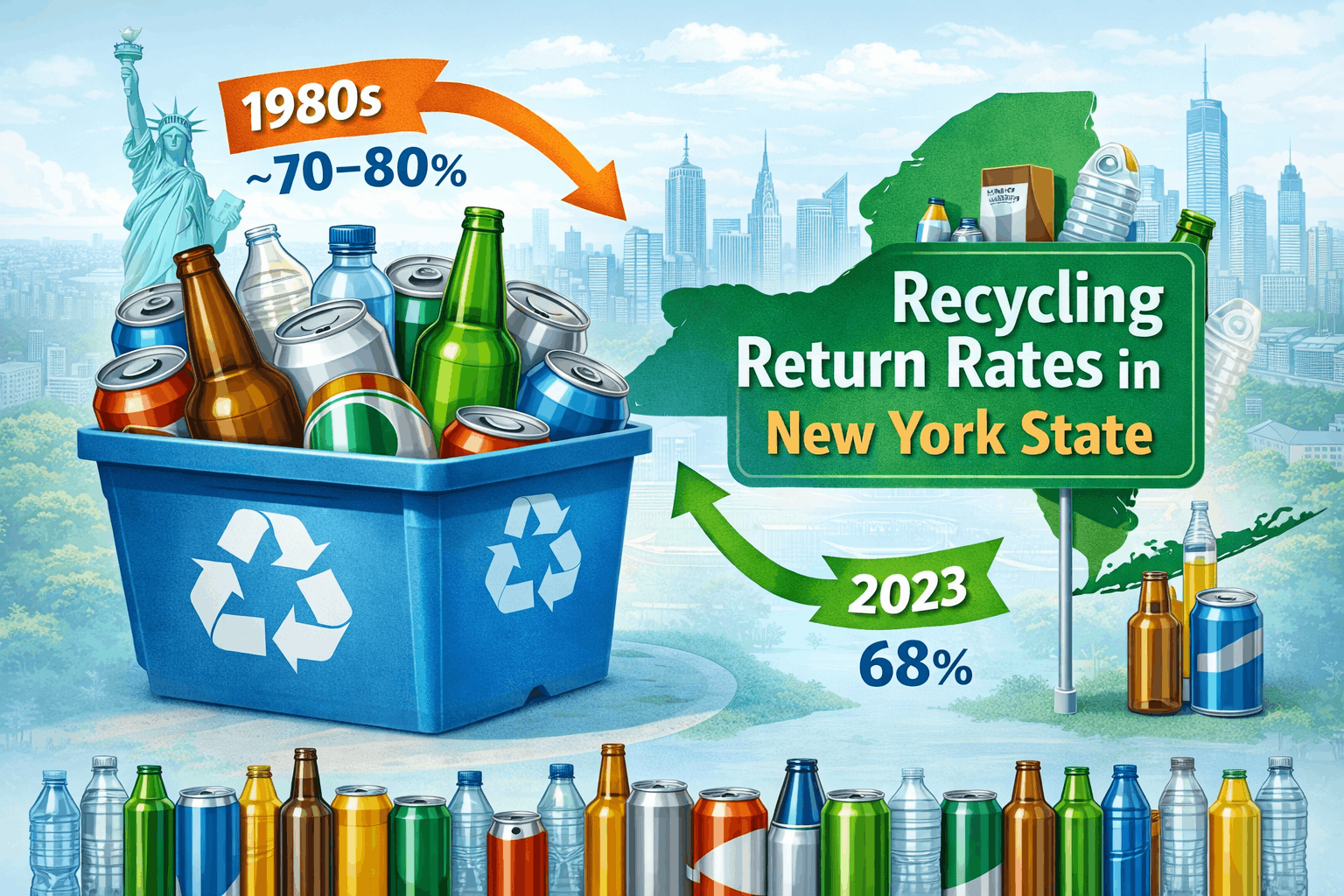
Over the past four decades, New York’s redemption rates have generally ranged between 60% and 80%, which is significantly higher than recycling rates in states without deposit laws. Below is a simplified overview of redemption rate trends.
New York Bottle Bill Redemption Rate Statistics (1982–2025)
| Year / Period | Estimated Redemption Rate |
| Early 1980s (program launch) | ~70–80% |
| 1990s | ~75–80% |
| Early 2000s | ~65–70% |
| 2007 | 66% |
| 2010 | ~65% |
| 2020 | 64% |
| 2023 | 68% |
| 2025 (approximate recent estimates) | ~65–70% |
Sources: New York State Department of Environmental Conservation and related Bottle Bill reports.
While redemption rates fluctuate with consumer behavior and economic conditions, the long-term average remains strong.
Overall, the program has maintained consistent participation for more than 40 years, demonstrating its durability and effectiveness.
Bottle and Can Recycling Rates in U.S. States Without Bottle Deposit Laws
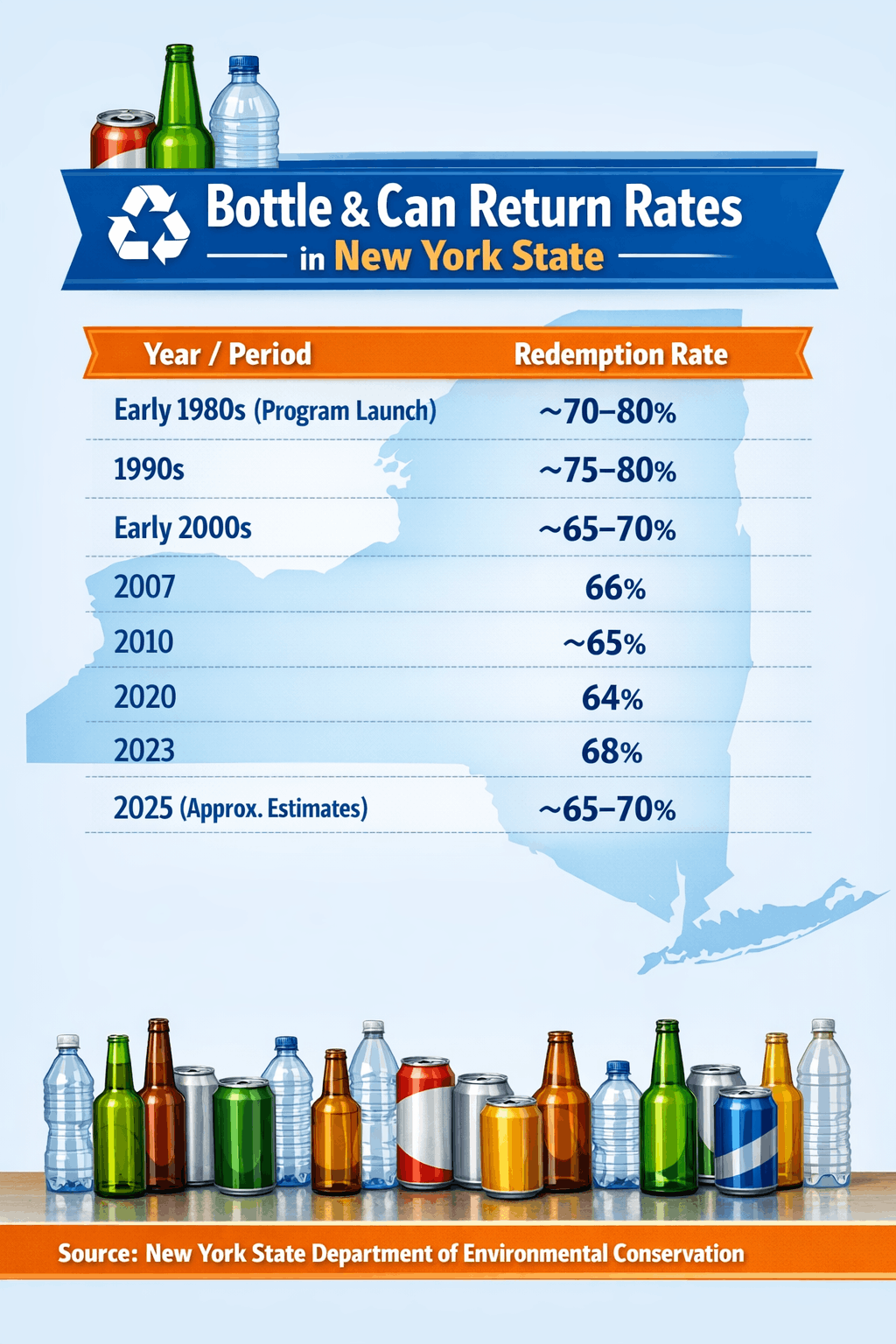
States that do not have bottle deposit laws consistently recycle far fewer beverage containers than states with deposit systems. Research shows that the average U.S. beverage container recycling rate is about 33%, but states with bottle deposit laws achieve recycling rates around 60–70%, while states without deposits often recycle less than half that amount.
In fact, studies estimate that states without deposit systems recycle only about 28% of beverage containers on average, meaning the majority of bottles and cans are either sent to landfills or become litter.
Because there is no financial incentive to return containers, recycling in these states typically relies only on curbside programs or voluntary recycling behavior, which leads to significantly lower participation rates compared with states that offer refundable deposits.
Estimated beverage container recycling rates (or closest available statewide recycling indicators) for states without bottle deposit programs.
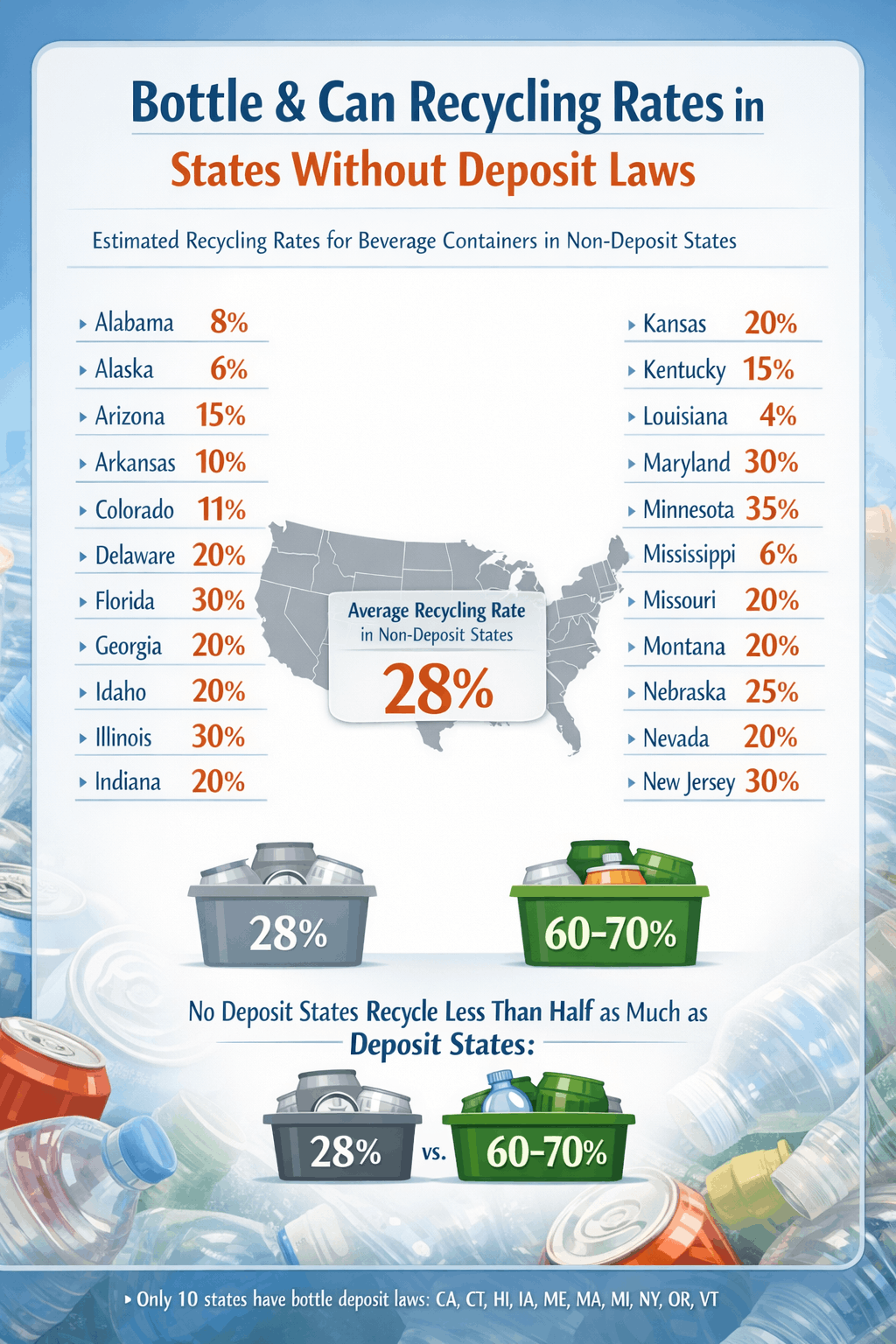
Note: Only 10 states currently have bottle deposit laws: California, Connecticut, Hawaii, Iowa, Maine, Massachusetts, Michigan, New York, Oregon, and Vermont.
The Environmental Impact of the Bottle Bill
When the Bottle Bill was first introduced, one of its main goals was to reduce litter and ease the burden on landfills.
Over time, the program has delivered measurable environmental benefits.
For example:
- More than 5.5 billion bottles and cans were redeemed in 2020 alone.
- Since the program began, billions of containers have been recycled instead of discarded.
- The law has prevented millions of tons of waste from entering the landfill stream.
In other words, the Bottle Bill doesn’t just encourage recycling—it dramatically reduces waste and pollution.
Why the Bottle Bill Works
In my view, the Bottle Bill works because it aligns environmental responsibility with financial incentives.
Most recycling programs rely entirely on voluntary participation. But the Bottle Bill adds a financial reward that motivates people to take action.
Several key factors contribute to the program’s success:
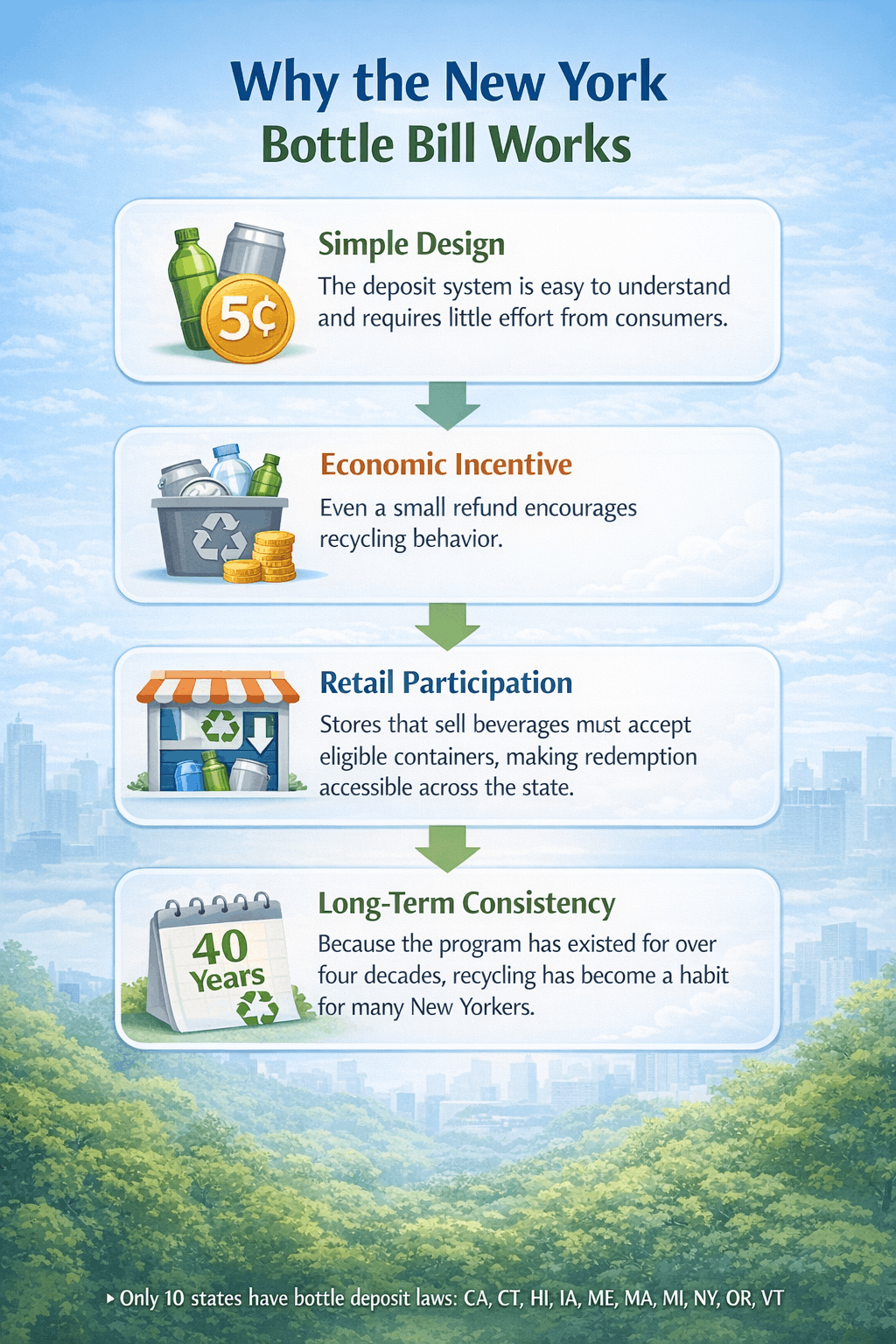
Simple design
The deposit system is easy to understand and requires little effort from consumers.
Economic incentive
Even a small refund encourages recycling behavior.
Retail participation
Stores that sell beverages must accept eligible containers, making redemption accessible across the state.
Long-term consistency
Because the program has existed for over four decades, recycling has become a habit for many New Yorkers.
Challenges and Opportunities for Improvement
Although the Bottle Bill has been successful, it has not remained unchanged.
The most significant update occurred in 2009, when bottled water was added to the list of eligible containers.
However, many advocates believe the program could become even more effective if it were expanded.
Proposals for modernization include:
- Increasing the deposit from 5 cents to 10 cents
- Expanding coverage to additional beverage types
- Improving support for redemption centers in the form of a higher handling fee
Higher deposit values in other states have resulted in higher redemption rates, suggesting similar improvements could increase recycling in New York. Speaking from personal experience in the industry, the handling fees have not changed since the bill’s inception in 1982, while minimum wage has skyrocketed since.
This oversight with the bottle bill is choking out redemption centers and making it harder and harder to simply meet costs. We support fair pay, but we need someone to notice that this inequity is driving redemption centers out of business.
Naturally, it is the part Albany is most opposed to. At Upstate, we are doing fine because we have the benefit of volume across 13 centers, but even the bigger centers like us are going to struggle to make ends meet if there are more hikes to minimum wage before they finally account for the fact that our fixed margins haven’t changed or accounted for inflation in 45 years.
The Long-Term Success of the New York Bottle Bill
When I evaluate the impact of the New York Bottle Bill, the evidence is clear: it has been one of the state’s most successful environmental policies.
For more than forty years, the law has:
- Recycled billions of beverage containers
- Reduced litter across communities
- Encouraged residents to participate in recycling
- Diverted millions of tons of waste from landfills
With redemption rates consistently above 60% and often closer to 70%, while non-redemption states are not even in the same ball park, the program has proven that simple incentives can create meaningful environmental change.
The New York Bottle Bill is more than just a recycling program. It is a long-standing example of how policy, economics, and community participation can work together to protect the environment.
About the author

Jack Flechaus
Head of Marketing & Events
Jack Flechaus hold a bachelors degree in business administration & marketing from the State University of New York at Fredonia.
Jack began his career with Upstate Bottle Return in 2019, building his foundation in the resale and processing of bottles and cans within the redemption business. Starting on the operational side of the business gave him firsthand insight into the systems, logistics, and customer relationships that drive the company’s success.
As his role expanded, Jack took on responsibility for payments and fundraising initiatives, helping streamline financial processes while strengthening community partnerships. His ability to bridge operations with outreach positioned him as a natural leader within the organization.
Today, Jack serves as Head of Marketing, where he leads brand strategy, customer engagement, and growth initiatives for Upstate Bottle Return. Drawing on his operational roots and financial experience, he brings a practical, results-driven approach to marketing, focused on expanding community impact, increasing customer participation, and reinforcing the company’s mission of sustainability and service.