New York State has authorized collection points designated to give you money back for your depositable bottles and cans. These places are called bottle returns or redemption centers.
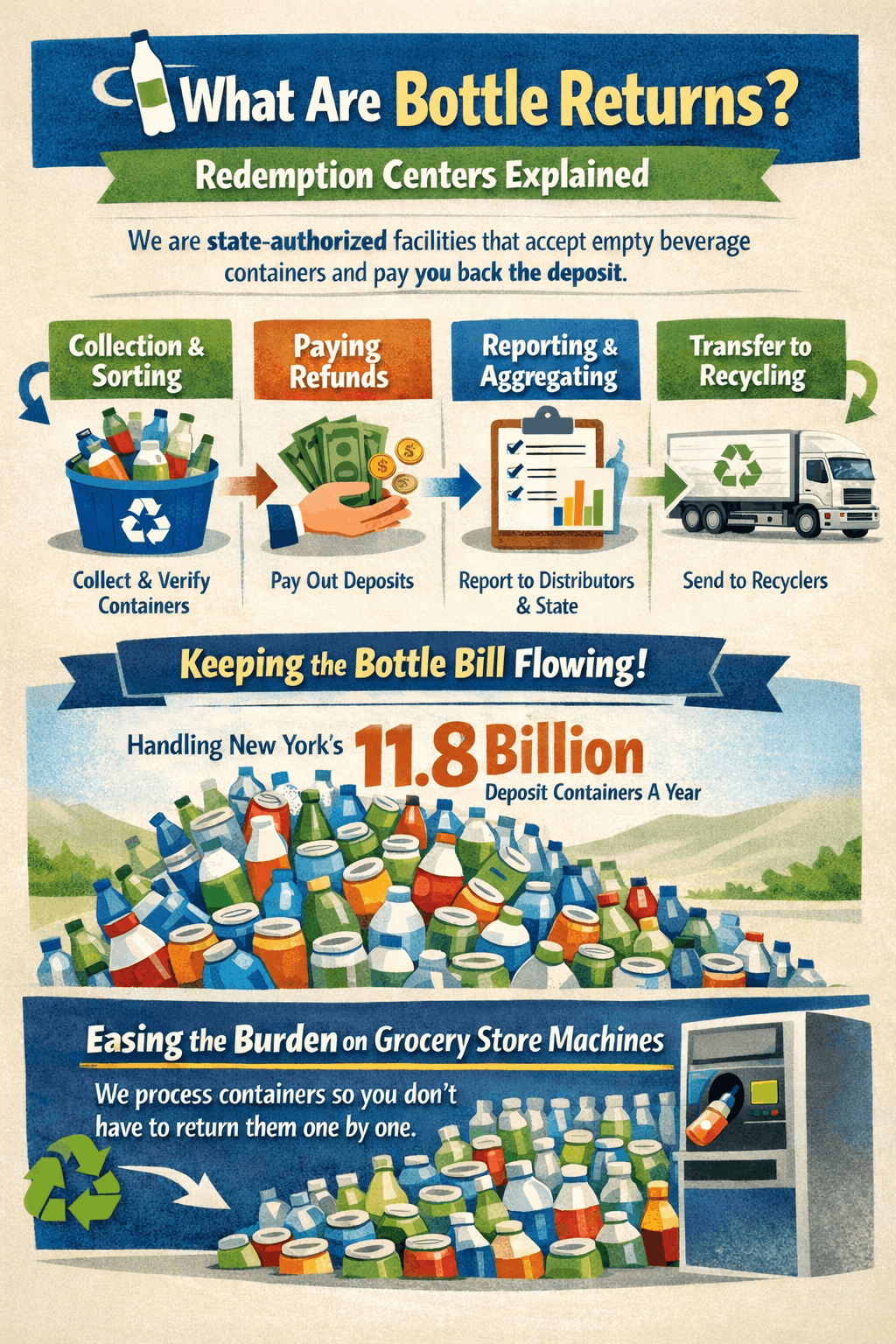
Redemption Centers act as:
- a collection point and a verification and sorting station,
- a payer of refunds,
- an aggregator and reporter to distributors and the state,
- and a transfer point to recycling processors.
Our work is what keeps the deposit system in New York running smoothly. Redemption centers play a crucial role in handling the huge number of depositable containers – we’re talking about 11.8 billion of them every year. Without the “pressure valve” of bottle returns, all of these bottles and cans would potentially have to go one by one through the return machines at the grocery store. As you can imagine, that would be a nightmare for wait times and would cost retailers a lot of labor costs to keep up with.
We operate under a law called the New York State Returnable Container Act, also known as the Bottle Bill. This law says that some drink containers sold in New York need to have a little extra money added to them, which you get back when you return the container. This extra money is like a deposit, and for a long time, it’s been five cents for each container. When you buy a drink, you pay this extra deposit, and then when you bring the container back, you get that money back.
We give back the deposit when people bring us their empty containers, as long as they’re the right kind. This program is meant to cut down on trash, get more people to recycle, and save resources by making it worthwhile to return things that can be reused or recycled.
What We Do When You Bring Containers In
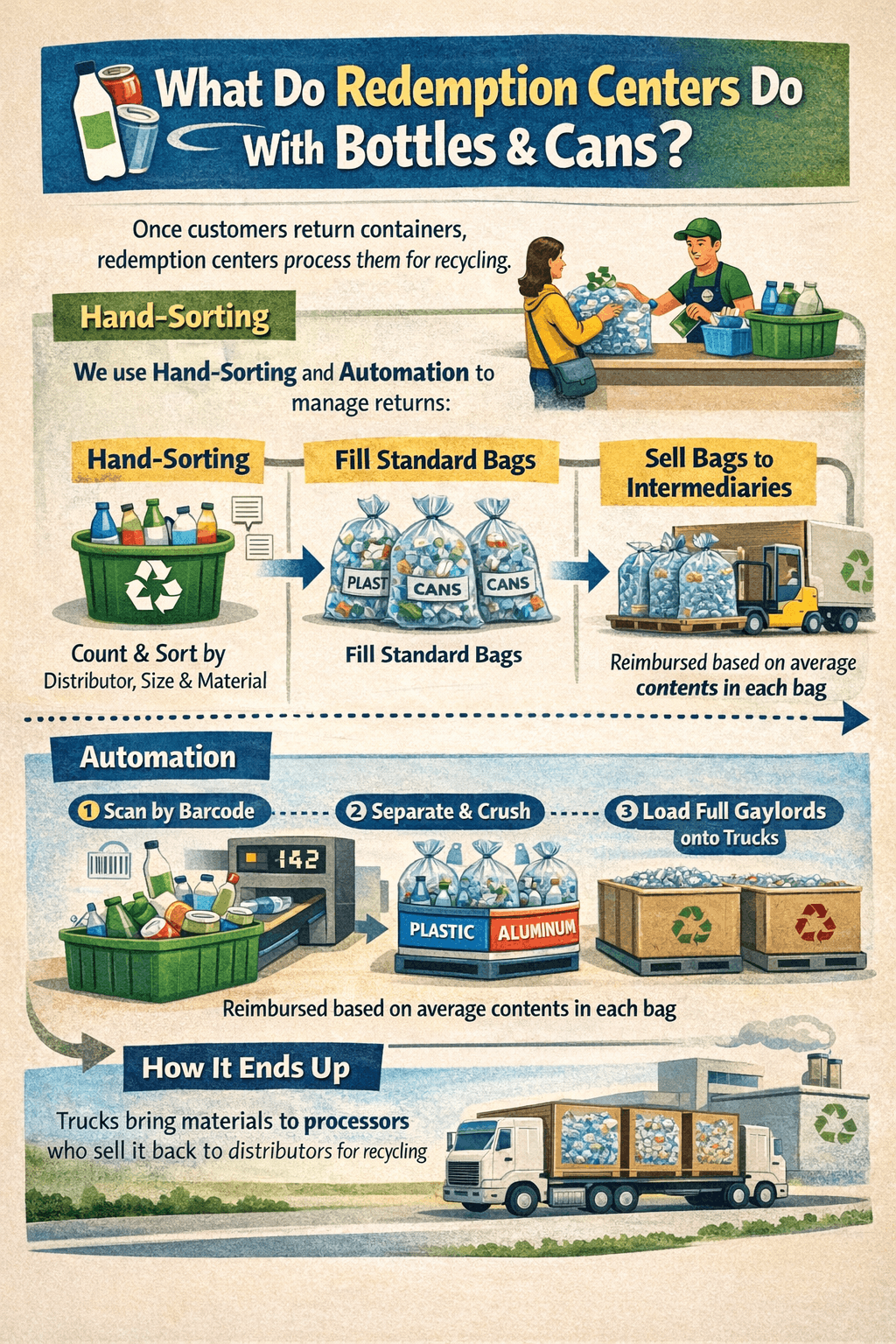
When people bring back their empty bottles and cans, the return center does one of two things: it either checks and counts them by hand or uses machines to do the job. If it’s done by hand, my team counts and sorts the bottles and cans into different groups based on who produced them, their size, and the materials they’re made of. We put them into industry-standard-sized bags. Then, we sell these bags to an intermediary factory, and they pay us based on how many bottles or cans fit in each bag, depending on the size and material.
When we use automation, we bring together artificial intelligence and large reverse vending machines. First, we run your bottles and cans through an automatic counter. Next, they are run through industrial-sized reverse vending machines. Then they split onto plastic and aluminum lines, scanned in, and crushed into large containers called Gaylords. Once the Gaylords are full, we load them onto trucks and send them off to the processors. From there, the processors sell the materials back to distributors, and the cycle starts all over again.
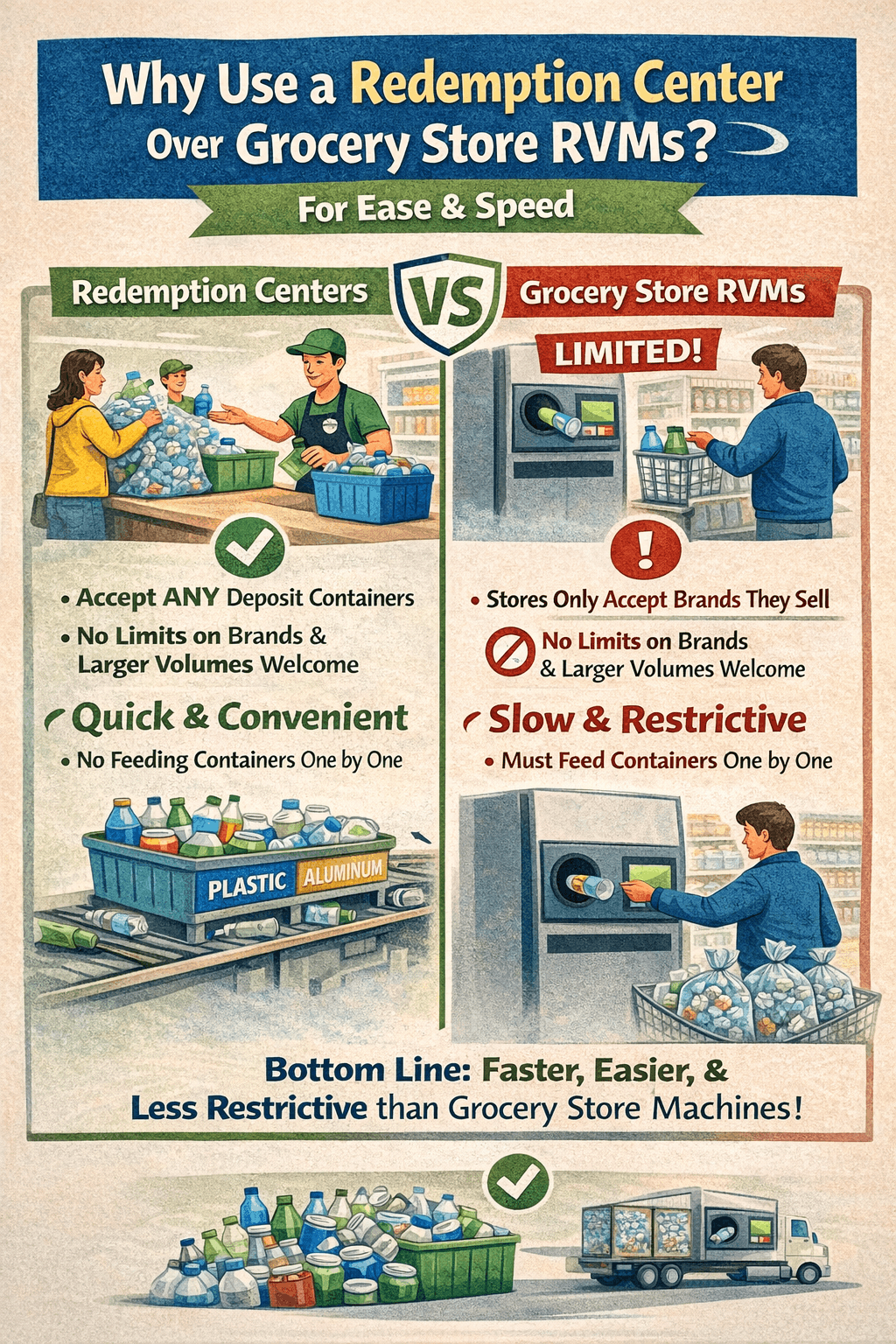
Why Use Redemption Centers vs. Grocery Store Return Machines?
When I talk to customers, I always highlight the benefits of convenience and quickness. You see, those reverse vending machines at grocery stores can be a bit of a hassle. You have to insert each container individually, and stores only take back containers for products they actually sell. It makes sense, since they’re responsible for the deposits on the items they sell, so they tend to limit returns to just those products.
Redemption centers are helpful because they don’t care where you bought your drinks. You can take any can or bottle with a deposit to them, no matter where you got it. This makes it a lot easier for people, especially when they have a lot of containers to return. Counting by hand can be a bit slow, but it’s still usually faster than using one of those machine things that you put each container into one at a time. Plus, redemption centers can handle big batches of containers, which is a big time-saver.
What Redemption Centers Pay
We pay back our customers the required deposit for each eligible container. For example, in New York, you get five cents back for every covered container you return. Some places might offer more money as a promotion, but that’s not something they have to do – it’s just a nice extra. The standard amount is set by the Bottle Bill, and that’s what we follow.
Before we pay, we verify eligibility: size, beverage type, material, and condition. Non-covered or damaged containers can be rejected.
Here’s how it works: the money we pay you comes from the deposit that was collected when the item was first sold. We work with the distributors and manufacturers to make sure everything is accounted for, and then we send back any returns. After that, we get reimbursed for the deposits, plus any extra fees that we’re allowed to charge by law.
How Do Redemption Centers Make Money?
So, you’re probably wondering how we make money if all we do is give back deposits. Well, it’s actually pretty simple. The Bottle Bill has a system in place where distributors or processors pay us a fee for each container we process. This fee is on top of the deposit that’s being redeemed, and it’s meant to cover our costs for things like labor, sorting, storage, and equipment. The best part is that this handling fee doesn’t come out of the customer’s pocket – it’s paid by the distributors or processors themselves. This way, when you return your bottles and cans, you get your full deposit back, and we get reimbursed for our troubles. It’s a win-win situation.
Beyond handling fees, our centers can improve profitability through several avenues:
Automation and bulk processing: Investing in automated sorting reduces marginal costs per container and raises throughput.
After all the recycling fees are paid, the collected materials like aluminum, glass, and plastic are sold to companies that buy these types of things.
Some recycling centers also offer extra services, like selling things that can help with recycling, or even drinks. Profitability depends on the reimbursement structure, operational efficiency, local return volumes, and overhead. Many small centers operate on thin margins and rely on consistent throughput and tight cost control.
Do redemption centers take all recycling?
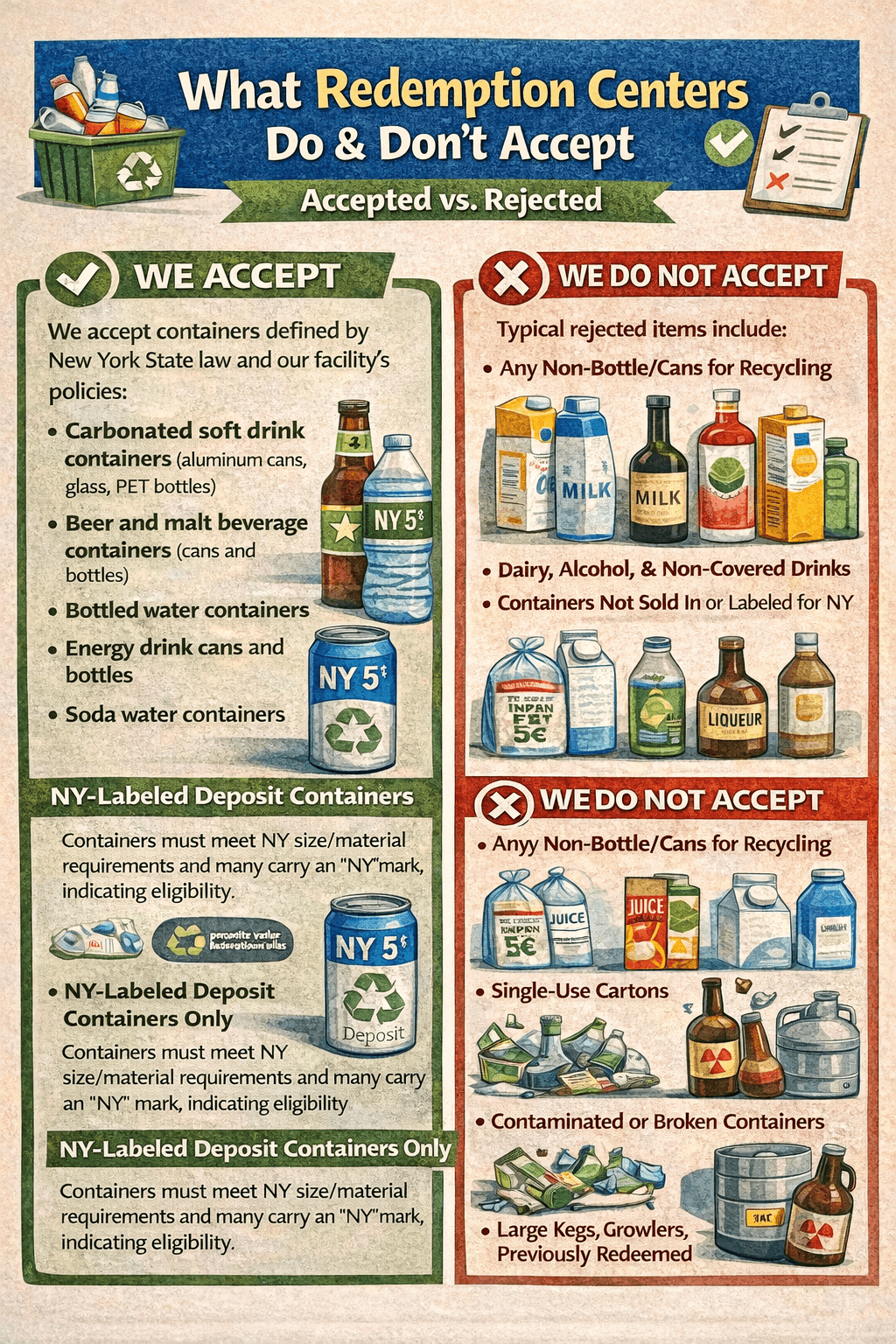
We take containers that meet the rules set by New York law and our own facility’s guidelines, which are posted for everyone to see.
Typical accepted items include:
- Bottles and cans for fizzy drinks come in different kinds, like aluminum cans, glass bottles, and PET plastic bottles.
- Beer and malt beverage containers (cans and bottles)
- Bottled water containers (plastic and glass)
- Energy drink cans and bottles
- Soda water containers
To be accepted, a container has to be the right size and made of the right material, as set by the state. Often, you’ll see an “NY” mark on it, like on a bottle wrapper or the top of a can, which shows it’s eligible. But sometimes, manufacturers make mistakes when printing labels. When that happens, we go by what the state says and follow the signs that are posted.
All non-depositable recyling should go in your blue recycling bin or be delivered to a local recycling facility to be sent through the standard recycling system. The adjacent video from SciShow is a great synopsis of how the standard recycling system works.
Verification, Sorting, Aggregation, and Reporting
When we first get the items, we check if they have a deposit. Then, we sort them into different groups like glass, aluminum, and plastic. We also take out the things that can’t be recycled. Our staff does this work. After everything is sorted, we put the recyclables together, keep track of what we have, and tell the intermediary how much we’ve collected. This gets us paid for our work and we get reimbursed by the intermediary.
After we’ve sorted and grouped everything, we get the containers ready to be moved. They either go to special facilities that can handle them or back to the companies that supplied them, so they can be recycled or refilled. It’s really important that we do all the paperwork correctly and send in our reports on time, so we can get paid back for what we’ve done.
Practical Tips for Customers
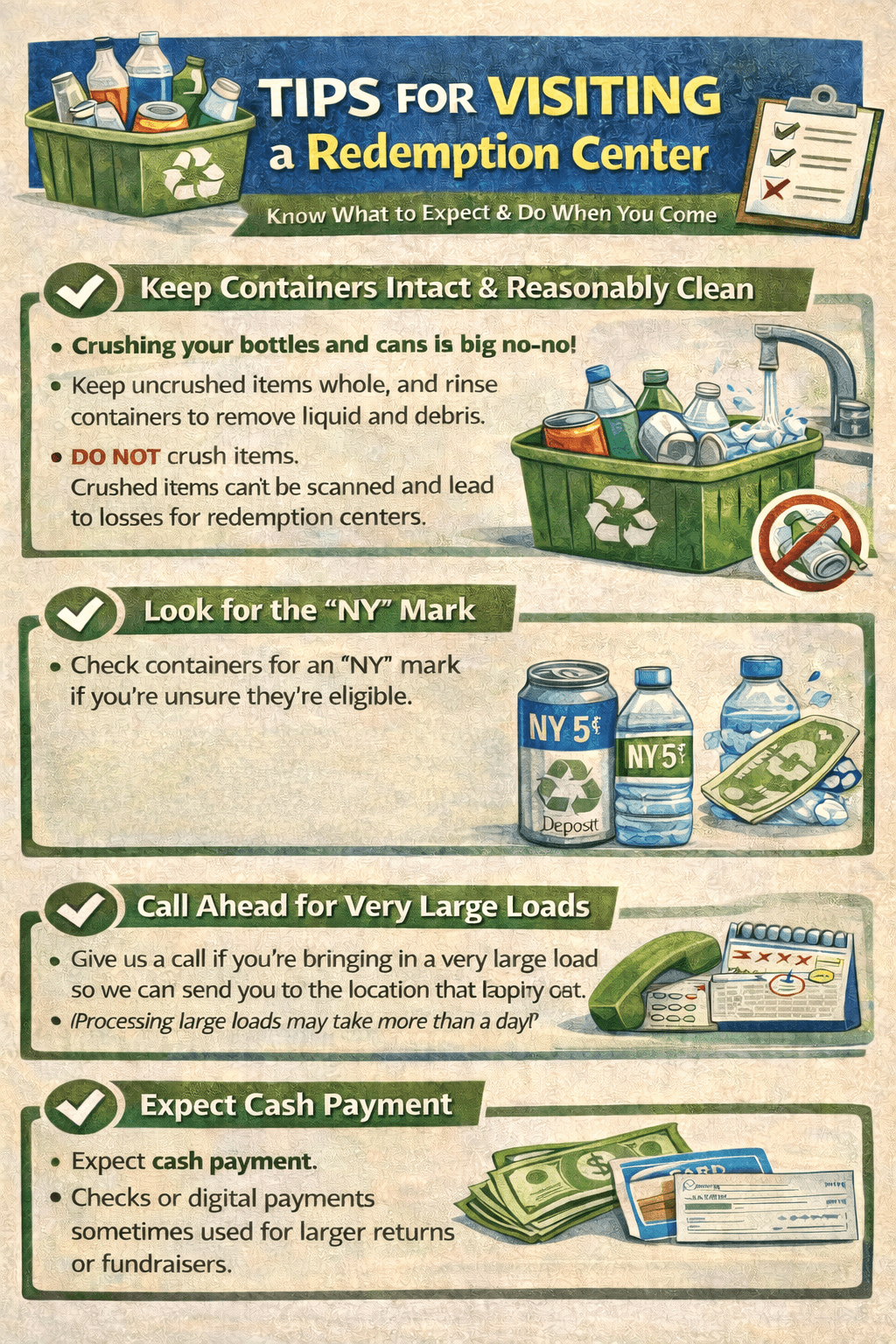
When you come to a redemption center:
Don’t crush your bottles and cans, it’s really not a good idea. We’re not sure why some people think they need to, but the thing is, bottle returns can’t accept crushed items because they can’t be scanned. When you put crushed items in bags that are sold based on average contents, it can lead to losses for the redemption centers. Just keep your containers intact and reasonably clean, that’s the way to go. It makes a big difference when you’re trying to return them.
If you’re not sure, just check for the “NY” mark or the deposit label.
Before you come in, give us a heads up if you’ve got a really big load. We might direct you to a different location that’s better equipped to handle it, so we can get your return processed quickly and efficiently.
Sources & Citations:
User, Super. New York – Bottle Bill Resource Guide. www.bottlebill.org/index.php/current-and-proposed-laws/usa/new-york#:~:text=80%25%20retained%20by%20the%20State,not%20required%20to%20provide%20refunds.
“New York’s Bottle Bill.” Department of Environmental Conservation, dec.ny.gov/environmental-protection/recycling-composting/bottle-bill.
Containers, Gaylord. “Gaylord Boxes | Buy, Sell and Recycle Nationwide.” Gaylord Containers, www.gaylordcontainer.com.
“Dealer Requirements.” Department of Environmental Conservation, dec.ny.gov/environmental-protection/recycling-composting/bottle-bill/dealer-requirements.
“FAQ.” NY BOTTLE BILL, www.nybottlebill.com/faq.html.
“Third-Party Systems and Related Companies.” Department of Environmental Conservation, dec.ny.gov/environmental-protection/recycling-composting/bottle-bill/third-party-systems-and-related-companies.
Assembly Home | New York State Assembly. assembly.state.ny.us.
About the author

Jack Flechaus
Head of Marketing & Events
Jack Flechaus hold a bachelors degree in business administration & marketing from the State University of New York at Fredonia.
Jack began his career with Upstate Bottle Return in 2019, building his foundation in the resale and processing of bottles and cans within the redemption business. Starting on the operational side of the business gave him firsthand insight into the systems, logistics, and customer relationships that drive the company’s success.
As his role expanded, Jack took on responsibility for payments and fundraising initiatives, helping streamline financial processes while strengthening community partnerships. His ability to bridge operations with outreach positioned him as a natural leader within the organization.
Today, Jack serves as Head of Marketing, where he leads brand strategy, customer engagement, and growth initiatives for Upstate Bottle Return. Drawing on his operational roots and financial experience, he brings a practical, results-driven approach to marketing, focused on expanding community impact, increasing customer participation, and reinforcing the company’s mission of sustainability and service.